
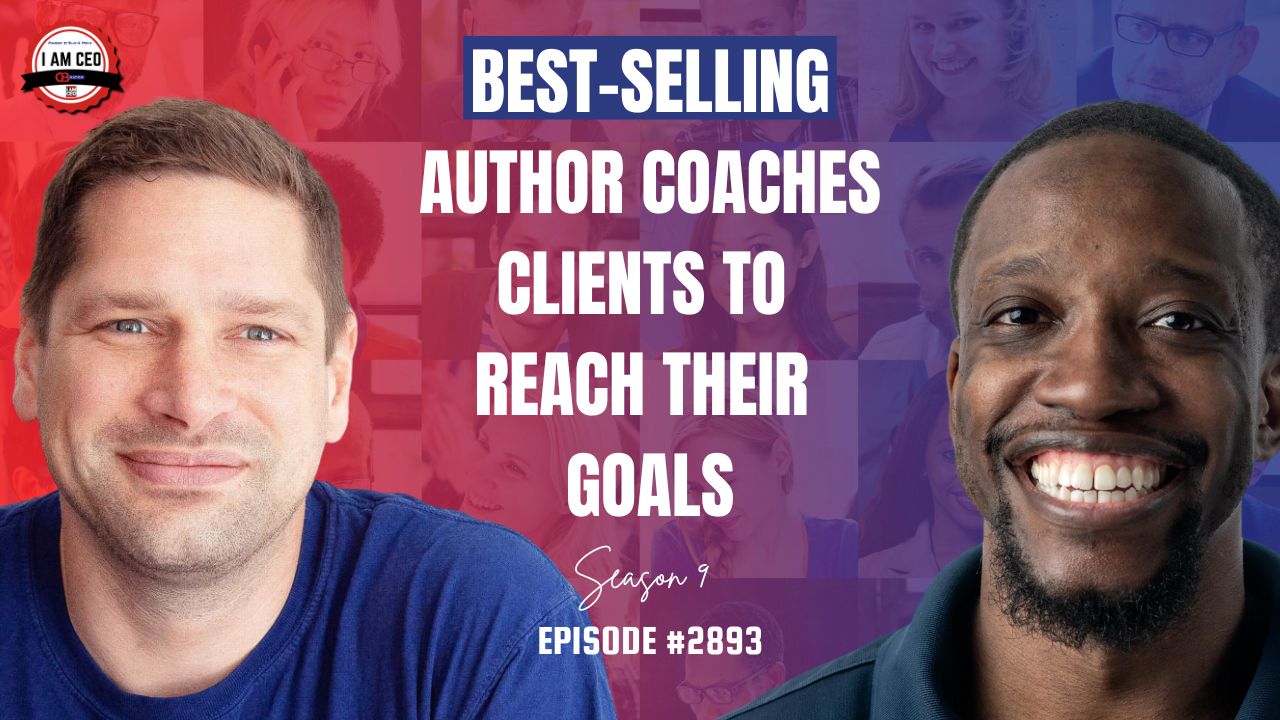

Robin Waite is a husband and father to two young girls, with a passion to help business owners set fearless goals and achieve great success.
Robin is a business coach, regular speaker at various business events and bestselling author of two books, including the recent popular release Take Your Shot. He puts his decade of business leadership experience to work, coaching clients to reach their goals.
- CEO Hack: Looking at things in these perspectives: Growth, Yellow and Red
- CEO Nugget: More thinking time to innovations as opposed to solving problems
- CEO Defined: Understanding what it is like to be a human being – emotional connections
Website: https://robinwaite.com/
Twitter: https://twitter.com/RobinMWaite
Facebook: https://facebook.com/RobinMWaite
Online Business Startup – http://www.amazon.co.uk/dp/B00W7LXGL0
Take Your Shot (360+ positive reviews) – https://www.amazon.co.uk/Take-Your-Shot-Business-Attract-ebook/dp/B074679GZ6
Previous episode: https://iamceo.co/iam522-best-selling-author-coaches-clients-to-reach-their-goals/
Hear Gresh's story, learn the 16 business pillars from the podcast, find out about CBNation Architects and why you might be one and so much more. Did we mention it was FREE? Download it today!
Transcription:
Robin Waite 00:00
Being a CEO, to me, I think it's actually the definition of like, being human being, just pure and simple. I think it's just you've got to have a very deep understanding of what it's like to be a human being. And I know that sounds a bit dumb because, like, sometimes we just take it for granted that, you know, we think that we're all decent human beings and we, we kind of miss a lot of like, the stuff, like the emotional connection with other people. That's the bit of being human, which I, I'm really kind of alluding to.
Gresham Harkless 00:53
Hello, hello, hello, this is Gresh from the I Am CEO podcast. And I have a very special guest on the show today at Robin waite of robin waite.com, robin, it's awesome to have you on the show.
Robin Waite 01:01
Oh, it's awesome to be agresh. Thank you so much for having me on.
Gresham Harkless 01:03
No problem. Pleasure is definitely all mine. What I wanted to do is just read a little bit more about Robin so you can hear about all the awesome things that he's doing. Robin is a husband and father to two young girls with a passion to help business owners set fearless goals and achieve great success. Robin is a business coach, regular speaker at various business events, and best selling author of two books including the M.O. the recent most popular release, Take youe Shot. He puts his decades of business leadership experience to work coaching clients to reach their goals. Robin, are you ready to speak to the IM C O community?
Robin Waite 01:31
Absolutely. 100%.
Gresham Harkless 01:32
Let's make it happen. So I wanted to hear my favorite question, which is your CEO story here, a little bit more about what led you to start your business.
Robin Waite 01:39
Yeah, absolutely. So straight out of school, I actually got a job as a systems analyst. So I've always been in kind of business, deep and deep entrenched in systems. I have a very numerical kind of brain, but I had a very good insight in the four years I worked in that business in, in terms of how to run a business and how not to run a business because the, the, the, the CEO, the owner of that business was super smart when it came to making the medical devices which we manufactured. But when it came to running a business. He had absolutely no idea. So it was, it was a great education from that perspective because normally people are busy telling you how, how you should do things or how you shouldn't do things. But at that point. So that was 2004, I finished there and ran a marketing agency for 12 years. Really for me it was about. Because I'd seen how not to run a business. I was like, I'm sure I can go out there and do this better. I was really into kind of systems and processes and the Internet was kind of really sort of blowing up in terms of kind of creating businesses online and I wanted to get involved in it. And yeah, I ran that business successfully for 12 years. Family comes along, decide that kind of, yeah, things have got to change a little bit. So I've got to create something which is a bit more sort of family oriented so I can spend a bit more time with my girls rather than run my agency. So set up a coaching practice and that kind of means that I have total flexibility over my hours. But also everything that I learned over 16 years running those two businesses, you know, I can now help other small business owners to, to grow their agencies, grow their coaching practices and not make the same mistakes that my old boss made all those years ago. And then maybe I made one or two mistakes whilst I was running my marketing agency as well.
Gresham Harkless 03:08
Yeah, that makes so much sense and I'm glad you said that because a lot of times you're absolutely right. When a lot of times, you know, you hear success leaves clues. So you know, order to be successful you have to emulate or at least follow and see what people are doing to be successful. But you're absolutely right, the best things you can sometimes learn is by saying, I don't want to do that, I don't want to follow that path. So I know I want to try to do whatever is going to help me get to where I want to be.
Robin Waite 03:28
That's exactly it. And thing is as well, there's a lot of stuff which they don't teach you at business school. So you know, you learn all the theory like Maslow's hierarchy of needs and stuff like that. And I don't remember the last time I was sat in a business meeting going now what was on the bottom tier of Maslow's hierarchy Theory is great but actually it's the practical implementation that makes the biggest difference and being able to see those results.
Gresham Harkless 03:48
Yeah, absolutely. And I think that obviously there's a, there's a place for it. But I Think the. The problem is a lot of times when you read a book or you get that kind of philosophical information, you have to be able to kind of make it super tactical so that people can kind of implement that from day. From day one.
Robin Waite 04:04
Yeah. And, I mean, that's part of the reason why it's probably a bit early to start plugging the book, but it's. It's. It's the right time. But when I wrote that book, it was. I wanted it to really be relatable because I think that one of the things that a lot of business owners are too afraid to really talk about is, like, emotional. Like, the emotional side of running a business and the impact that it can have on you and your family and everybody else around you. And when I. When I write Take youe Shots, it's told as a parable. It's told like a story about one of my early clients. And, you know, it starts off with this guy who's just in dire straits with his business. He's really struggling. His wife's giving him a hard time and wants to turn it around. And he kind of has this opportunity, meeting with a business coach whilst he's going about his day job. And then things kind of start to piece together. But I wanted to. It was really specific about tapping into people's, like, emotions. And you see online so much about, like, how amazing businesses and how great businesses, and look at me with all of my Instagram bling and all this sort of stuff. And it's like, you know what, actually behind the scenes, you know that people are, like. People are having a tough time. Like, the Internet has made marketing, like, pretty hard. Like, you have to all of the successful businesses out there. There's a lot of hard work, effort, and tears and sweat which have gone into growing that business, you know, and it shouldn't be all, like, all of the glamour and the glitz of what you see on kind of Instagram and Snapchat and all these channels out there. Somebody who I think does it incredibly well is actually Gary Vaynerchuk. Like, you know, you've got it. He's a bit like Marmite. You either love him or hate him, but, you know, he kind of. You get to see, like, the real side of the. I've had the pleasure of seeing him speak live a couple of times, but you get to see, like, the hard work that that guy's kind of put into it. And he's got such a clear vision for, like, where he wants to take Vaynermedia and That business, even when he was, it was back when he was kind of running wine library and you know, building that shop up for his dad and doing Internet marketing, he still had like a really clear vision that he wanted to help his dad get to like it's a family run business but like to a multimillion dollar business to prove that he knew what he was talking about when it came to marketing. And they took all of that knowledge and now lays it down for like the vision. Not sure about his plans to buy. Is it the jets I think he wants to buy but you know, which is cool, you know, each to their own. But I wouldn't buy that team. I don't know.
Gresham Harkless 06:02
Yeah, well, you might be able to get them at a low even though they think they won this weekend that we're recording this. You know, you never know. Maybe they're on a high right now. But no, it makes so much sense. I appreciate you for, you know, talking about your book and writing the book for one, because I think there isn't as much information about that emotional side of running a business. Because I think a lot of times as we talked about like Maslow hierarchy needs or accounting or you know, bottom line, all those things are very, you know, business focused, but they're not necessarily as much people focus. And the emotional aspect of running a business, ups and downs that go with it, the frustrations, the joys, the highs, you know, and everything in between, a lot of times you forget that aspect. And even when you're running it, it can be kind of frustrating because those things do kind of help determine if you're going to be successful or you're not going to be successful.
Robin Waite 06:43
That's exactly it. I think as well, like not many people are honest with you when you set up a business as well to start off with, nobody tells you that it's going to need a bit of hard work. It's not necessarily hard. I learned a really valuable lesson. So I do a lot of cycling in my spare time, like road cycling. And I, when I first started out, I was going up this local categorized climb, quite a steep hill and I totally out of shape. I had to stop two or three. In fact, it probably would have been quicker if I just got off the bike and walked up this hill, right? But this guy comes whizzing past me with all the lycra and the gear on, the glasses and the hat and stuff and I shouted at the res, oh, you're making that look easy. He was so far up the road. I Didn't hear what he said, but it's a great community and he, he around cycling. So he stopped at the top of the hill and he must, he must have waited there for ages. It took me about 20 minutes to get up this thing and we had a good chat and then he said that thing you said when I went past, he said, said, you know that like cycling never gets any easier, you just go faster. And I was like such a valuable lesson to learn. Not just like for cycling, but in sport, whatever you lay your hand to you just through practice, you just get better and better and better. And in getting better at it, through that hard work, you actually start to enjoy the process even more because you know that like all of that practice is starting to pay off. You start to score the goals and get clients that you never thought you could get and you know everything. The business starts to grow because of how you've designed it. Not just through luck, you know, and bit of trial and error and luck. No, actually it's through sheer practice and hard work. And that's when like business becomes so satisfying.
Gresham Harkless 08:07
Yeah, Then it makes so much sense and you kind of forget that, you know, when that person was, was whizzing by, you know, you think that he's not working as hard as he was before, but he might be working as hard, if not even harder. He's still putting in that work to, to execute on that process in order to get to where he wants to be. Just the, the end of it, the end game or what Exactly. The output, I guess of everything is actually maybe a lot better than probably when he started. So I appre you for, for sharing that, that perspective with us. No worries. Yeah, absolutely. And so I know you touched on your book. Was, was there any other things and I know you do like coaching as well too. Are there any other things that you do to kind of support the clients you work with and, and what do you feel kind of sets you apart and makes you unique?
Robin Waite 08:42
So we, we in terms of, from a coaching perspective. So we kind of, despite the fact I run a marketing business for 12 years, I was like, right, this, this coaching thing, like I don't want it to be about marketing. One of the bits that I really enjoyed about the marketing business. So we used to do web design and branding basically. So like you know, glorified logo design process and this obviously going back a few years and in about sort of 2013, 2014, I started to innovate what we were doing and a lot of service based businesses. You End up with this, I call it like agency ping pong. This back and forth between client and supplier and you know, it starts in the whole process of them asking for a quote and it gets back, battered, back over and like we had this really clunky design process and it's the same for any graphic design business where it would take like three months to, to deliver a logo to somebody. Because the communication going back and forth to ping pong and I was like, there has to be a better way. So I worked out what the seven steps were in the process and it cut it down to like four to six weeks. And I was like, it still isn't good enough. It has to be better. This is my old systems brain kicking in, systems analysis brain kicking in. And then so I thought wouldn't it be cool if we could do this whole process, these seven steps in one day. So we create this one day branding workshop and the first client we did it for was like, I need, I've got some, I've got an exhibition coming up, I need some printed stuff. Stuff like we need, I need this logo like tomorrow. Can you do it? And I was like, well yeah, we've got the capacity, we'll get a design, you know, one of my designers in and we delivered it and when we delivered it, we deliver it, delivered it for like three times the going rate for like the going hourly rate for graphic design. We ended up doing about 40, 45 of these like throughout the next 12 months. One of them, somebody wanted to put me in a room with 23 of their like basically their entire team. And I said well that would be 10k because it's like let's, I've got to work harder for that. So it's going to cost you a bit more money. So it's like this, you know, and actually in those days like graphic design, especially logo design, you do like 10, 10 or 12 like billable hours, like 50 pounds an hour, you know. So you know, we were charging like a really good rate. But people start to see those one day branding workshops and they're like, that's really cool what you did with your service. Like do you think you could do that with my business, my products? And I was like, yeah, I reckon I probably can. My whole coaching program is actually fearless. Business is based around like taking traditional service based businesses kind of wrapping them up into like. So you end up with a very specific set of features, very clearly defined outcomes and results from it over a very specific time. And it's for a fixed Price, which is normally like a lot higher than the typical hourly rate most service providers are doing with that obviously comes, you know, higher prices and so, you know, better products, high price. They've got to get better at selling. So we kind of COVID off those three, three core pillars and with a little bit of sprinkling of kind of marketing stuff in between. Because obviously we want to help our clients, like, get more clients as well. It's not just about kind of maximizing those opportunities, but how can we also get more opportunities? It works incredibly well. Like, we've had people, you know, we had a coach who hadn't had any clients in like, nine, nine months since starting out his practice. And within eight days of starting to work with us, he got his first client in for 1800 bucks. So it's like, you know, when you. And we've got. We've had clients who've got, like, they've been able to afford to get married, they've been able to afford to get deposits for houses and, like, move into their first home. We've had two of our clients had babies in the last 12 months. And it's like that side of business, which is really where it's at.
Gresham Harkless 11:44
Yeah, that makes so much sense. I wanted to switch gears and I wanted to ask you for what I call a CEO hack. So this might be what you kind of touched to, and it could be like an Apple book or habit, but is it that ability to realize that there is a human aspect of business that you feel kind of sets you apart and makes you more effective and efficient?
Robin Waite 12:00
I think one of the most important things is about time and how we use that time. So not just in the workplace, obviously, but outside the workplace. Now, outside the workplace tends to kind of just looking after yourself, you know, exercise and, you know, sleep and things like that. But I think within the workplace is a very good friend of mine. Actually, you won't have heard of him.
Gresham Harkless 12:21
He's.
Robin Waite 12:21
He's kind of very new on the scene in terms of. From a coaching perspective. But I actually wanted to share with you guys because he's literally just put his ideas into a book. Guy called Paul Holbrooke, and his book's called what are you doing? It's literally just come out. But I did some work with him last year around time, and he talks about the fact that you break time down into four key activities. So the first one is about growth activities, so thinking, communicating, and improving, basically. You then have the yellow activities, which are the next ones, which are like the management Activity. So it keeps business kind of going like at the same level. So you've got growth, you've got keeping business at the same level. And that's like monitoring, directing, management type activities. And then actually you've got. And this was really interesting was when he said you've got than the red activities, which actually pushes the business backwards. And I was like, so what are those? And he's like, well, it's all the doing activities in the business. It's actually like because if you're not going out and speaking to people, if you're not going out and creating new ideas like growth, the business is naturally just going to start to lag behind, like all your competitors.
Gresham Harkless 13:20
Where are they?
Robin Waite 13:20
Wow, that's a really interesting way of like looking at things.
Gresham Harkless 13:23
Yeah, that makes so much sense. So now I wanted to ask you for what I call a CEO nugget. And this is a word of wisdom or piece of advice or if you can happen to a time machine, what would you tell your younger business self?
Robin Waite 13:33
My younger business self, I wish that I'd actually, in 2004, rather than building websites for other people, actually started building apps for myself. 2004 was the year. Do you know what actually Pop quiz.
Gresham Harkless 13:43
Crash.
Robin Waite 13:44
What, what. What do you reckon happened? It's pivotal. What happened in 2004?
Gresham Harkless 13:49
2004 was I doing in 2004? I was. I have no idea. I was. 2004.
Robin Waite 13:55
Wasn't.
Gresham Harkless 13:55
Have no idea.
Robin Waite 13:55
I was that website which came into the. Which was built. Half the world is on it now.
Gresham Harkless 14:00
Half the world. I want to say Google, but close. Facebook. Facebook. Facebook.
Robin Waite 14:05
So Zuck was in his dorm room and he just launched Facebook. What is called the Facebook then, wasn't it? To his college students in Harvard. And yeah, I wish that sometimes I'd paid more attention. See, I didn't have enough thinking time and that's the challenge. I think if I'd had more thinking time, I'd have come up with the idea. It wouldn't have been Facebook, let's face it can only be one Facebook. But I wish I'd spent more time focusing on innovation as opposed to like for my own business as opposed to like focusing on helping other people's problems. It's important. It helped me get here today, but. And now I know that piece of advice, you know, I do kind of. I'm doing a lot of stuff behind the scenes to innovate, but definitely that thinking time needs to be put onto innovation.
Gresham Harkless 14:42
That makes so much sense. So now I wanted to ask you my Absolute favorite question, which is the definition of what it means to be a CEO. And they're going to have different quote, unquote CEOs on this show. So rather, what does being a CEO means here?
Robin Waite 14:53
Being a CEO? To me, I think it's actually the definition of like being human being, just pure and simple. I think it's just you've got to have a very deep understanding of what it's like to be a human being. And I know that sounds a bit dumb because like sometimes we just take it for granted that, you know, we think that we're all decent human beings and we, we kind of miss a lot of like the stuff like the emotional connection with other people. That's the bit of being human, which I, I'm really kind of alluding to.
Gresham Harkless 15:16
Robin, thank you so much. I appreciate you. I appreciate that definition, appreciate your time even more. What I wanted to do is pass you the mic, so to speak, just to see if there's anything additional you can let our readers and listeners know and then of course, how best they can get a hold of you and find out about all the awesome things you're working on.
Robin Waite 15:29
Yeah, absolutely. So I mean if you, if you google Robin Waite and that's weight with an E on the end of it, I always have to tell people. Cause otherwise they'll just end up, I don't know, there's some random kitsap soccer coach in Canada. Like you'll find his website but. And the one with the E on the end of it. But if you just google me, you'll find I've got a YouTube channel with about 150 videos on there, all things sort of coaching. And also we've got a website which is Fearless Biz, which we've got some other free resources on there just to talk, just to introduce people to the concepts around sort of Fearless Business and like the product pricing and sales side of things we talked about. And if anybody wants to kind of help out, I'm kind of looking for people to review, take your shot. So if you've got any listeners based in the uk, I'm happy to send out ship out paperback copy of that book. There's a form to fill in on Fearless Biz. But also if any of your listeners over in Stakes, it'll be a PDF version of it. But I'm happy to give people a free copy of the book if they're happy to leave a review of the book. That'd be super helpful.
Gresham Harkless 16:18
Thank you so much again, Robin. Truly appreciate it and I hope you have a phenomenal rest of the day.