
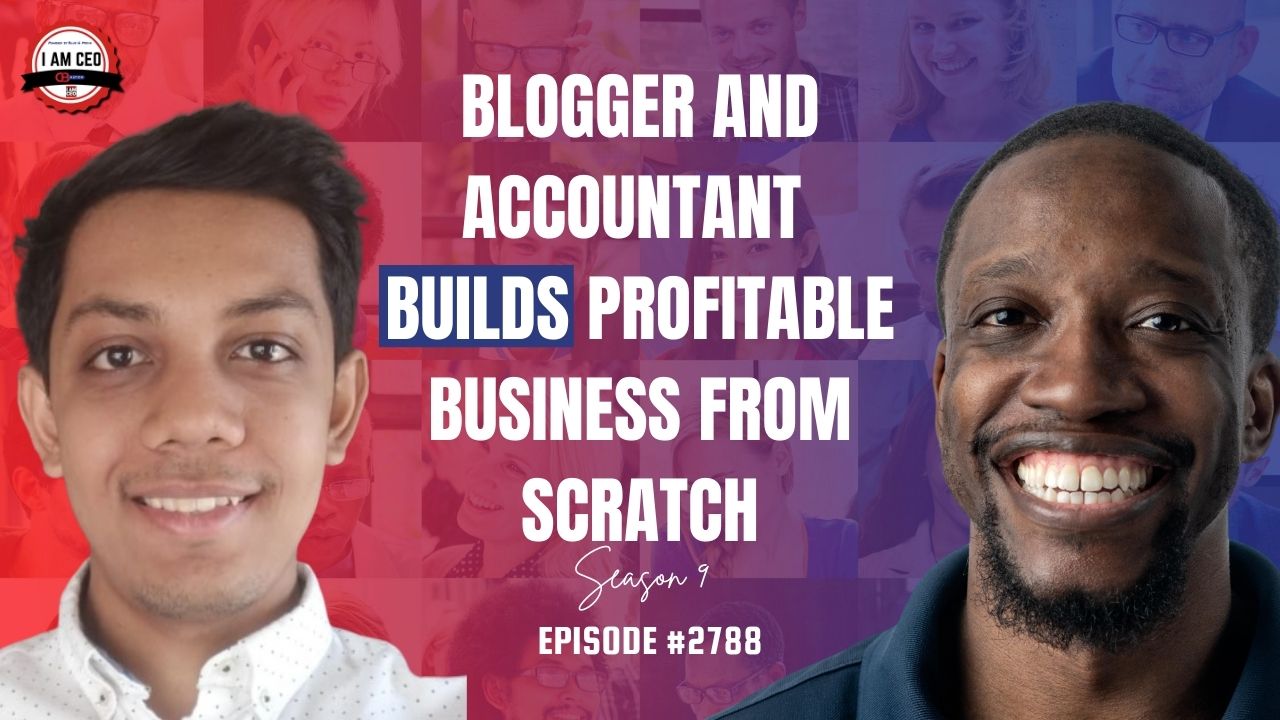

Rishit Shah is a blogger and an accountant. But more than that he is an entrepreneur who knows how to build up a profitable business from scratch. He also plays flute in his free time.
- CEO Hack: Yoga and Book- Managing Radical Change
- CEO Nugget: Try to acquire more skills
- CEO Defined: Someone with a unique vision
Website: https://www.tallyschool.com/
Facebook: https://www.facebook.com/tallyschool
Previous episode: https://iamceo.co/iam455-blogger-and-accountant-builds-profitable-business-from-scratch/
Hear Gresh's story, learn the 16 business pillars from the podcast, find out about CBNation Architects and why you might be one and so much more. Did we mention it was FREE? Download it today!
Transcription:
Rishit Shah 00:00
try to acquire more skills. That's what I said earlier, but this is very essential. Try to get more skills, not necessarily master every skill. Just try to know about it and try to be a beginner. That helps a lot.
Gresham Harkless 00:43
Hello, hello, hello. This is Gresh from the I Am CEO Podcast, and I have a very special guest on the show today. I have Rishit Shah of tallieschool.com. Rishit, it's awesome to have you on the show.
Rishit Shah 00:52
Yeah, thank you for having me, Gresham.
Gresham Harkless 00:55
No problem. Super excited to have you on. And what I wanted to do was just read a little bit more about Rishit so you can hear about all the awesome things that he's doing. And Rishit is a blogger and an accountant, but more than that, he is an entrepreneur who knows how to build up profitable businesses from scratch. He also plays flute in his free time. Rishit, are you ready to speak to the I Am CEO community?
Rishit Shah 01:12
Yes, I'm very, very excited to speak to the I Am CEO community and sharing all my insights that I have.
Gresham Harkless 01:20
Nice. Well, we're definitely excited to have you on. So I wanted to actually kick everything off with what I call your CEO stories. I wanted to hear about your background and what led you to get started with the business.
Rishit Shah 01:29
Yeah, so basically in India there's a course called Chartered Accountant. I don't know what it's called in the US, but it is near to the CPA course, that is Certified Public Accountant. So I had my internship and in the last year of the internship, I discovered Tally, an accounting software, and there's a lot of demand for that in the market, but no credible or good websites to provide that solution. So I just started a blog on that by seeing that there are no good people in the, in the market to provide good education on that particular software alone. So I started the blog, I started explaining through videos and the blog, and then with a little bit of SEO knowledge, it took off in nearly 6 months. And after around a year, I started earning good amount of money through the course that I was selling on Kelly School, which is the name of my website. And then gradually I funded my CA tuition fees as well from that blog. And that blog is, I'm still continuing with that blog. So this is the story how I came up with the idea and how I implemented it.
Gresham Harkless 02:48
Well, nice. Well, I definitely, you know, appreciate that. I also appreciate kind of like the step-by-step nature of it because I think a lot of times when we hear about businesses, we hear about starting a business, we don't necessarily hear about the steps it takes to get to where, you know, whatever success is, which is always different for all of us. But I appreciate you for kind of breaking that down and be able to kind of take step by step by step and be able to take whatever profits you were making from the blog and reinvest it into you continuing your education as well too.
Rishit Shah 03:11
Yes, actually what I had done was before starting penny school, I actually started 2, 3 blogs and I failed at that because that was the beginning. I was just pouring into the internet market for the first time. I got internet for the first time when I was in high school. So I had failed for on 2, 3 blogs. Then I got the idea how the entire thing works. Then took a step forward after actually checking if there is a market or not. So I saw if there is any good player in the market, if there are bad players in the market. If the solutions, if the thing that I wanted to provide to all the people who wanted to learn that particular software, if there is particular demand or not. And then I actually started the blog and then went on with that. So a huge success of this blog is actually before starting the blog, I tested the market and then I implemented it. Obviously there is a little bit of luck in everything every entrepreneur does, but Still, I try to reduce the luck factor as much as possible.
Gresham Harkless 04:14
Yeah, that makes perfect sense. It's like you can't always guarantee success and guarantee that, you know, you will be successful and reach whatever goal, but you can kind of stack the deck. And I think a lot of times when you, especially if you have the opportunity just to start and create like a blog and you may not go the way you necessarily want it to go, like you mentioned in the first two months that you did, but you still have those learning experiences that you can kind of carry on to the next venture and the next venture and the next venture. And I think a lot of times as entrepreneurs and business owners, we kind of forget the process that goes into creating something that's successful.
Rishit Shah 04:42
Yes, actually, we have to learn from that, from our failures, to able to succeed the next time. Otherwise, it's just repeating your failures one by one. And if this cycle goes on, just like if we learn from our failures, the success cycle always goes.
Gresham Harkless 04:59
Absolutely. Absolutely. So I know you touched on it a little bit. Can you tell us a little bit more about Tally School and what exactly we can find there?
Rishit Shah 05:06
Okay. Tally School is a website or a blog. You can call that. Where you can learn Tally, a particular software which is popular in India and the Middle East. So it is an accounting software. It is an ERP, but majorly it is used for accounting and you can learn that particular software on Tally School.
Gresham Harkless 05:24
Nice. That makes perfect sense. And like you kind of touched on, you know, before, like getting an opportunity to make sure that there was a market to make sure there was opportunity for there. And there was some value that you can provide and seeing that, you know, that wasn't being provided. To the level that you've been able to do. I think that that's, you know, something, you know, very, very great to kind of take and keep in mind as an entrepreneur or business owner.
Rishit Shah 05:43
Yes, because many times we get, we fall in love with the idea, but we don't test the markets. So it is very essential to test the markets because no matter how good or how lovable the idea looks to us, but if there is not enough demand or If we are not able to implement it with the resources that we currently have, then that idea, maybe, maybe it can make billions, but if we cannot implement it with whatever the resources and time we have, then that idea is useless to us. That's the thing. If, let's say, for example, if you get the idea of starting Uber, but you cannot scale it or you don't have the necessary resources, then it is not useless to you., and it can be a billion-dollar company, but for us, it is not, it is useless. That's what I'm trying to say.
Gresham Harkless 06:33
Yeah, that makes perfect sense. And just kind of keeping in line and understanding those different aspects and understanding like some of the things as well that you need to kind of, if you know, whatever your vision and your goal is to grow your business, if it is to scale it like an Uber, or if it's not, you know, just understanding like what sometimes those opportunities not only can be, but also what's required to make those opportunities turn into that success as well too.
Rishit Shah 06:55
Yes, definitely. We need to see if we can implement it better because without implementation, idea is just in your head. It's nothing of value. So if implementation is good, if there is a good market demand and you see that you can fill up a gap, which is very essential for a lot of people, then your idea, your, with your execution, it will be successful.
Gresham Harkless 07:22
Absolutely. Absolutely. So now I wanted to ask you for what I call your secret sauce, and it could be for you or your organization, but what do you feel kind of sets you apart and makes you unique?
Rishit Shah 07:31
So what sets me apart is that I know a lot of skills. Now, I'm, this might sound like I'm bragging about myself, but actually I'm trying to explain that one skill, the times of one skill, single skill has gone. You have to have at minimum more than 2 skills to succeed today. So for me, before starting Career School, I kind of played on the internet and a lot of like pay-to-click websites and small surveys. And I've done all that for $1, $2, $0.50. My, actually my first income was $0.25 US. So I started from there and. So I know, knew a lot of skills. I knew SEO. I still know SEO. I have a good writing experience. So that helped me. I wrote as a freelancer before as well. So that helped me starting the blog and accounting knowledge, which I had because of my CA course. So the mixture of this multi-skills helped me a lot because in my field currently, if I see the competition. The people who have accounting knowledge don't have the SEO knowledge well. The people who have the SEO knowledge don't have the accounting knowledge. So if I mix the skills, I can be ahead of the competition. And that is what is currently going to be the differentiator, because even if you start up a new company, the more skills the people have, the better. So this is what my secret sauce is, Christian.
Gresham Harkless 09:03
Nice. I definitely appreciate that, Rishik, because I think a lot of times, um, we get siloed into thinking that, it's just like one aspect, but especially when running a business, having a business, you know, having and building and growing out a blog site, whatever that might be, um, that we're trying to do. Um, we kind of sometimes forget like all the different aspects of that. And like you either, you know, develop those skills or potentially have somebody on your team that has those skills that helps to, to make you, um, create that kind of moat that, that way that people can't, you know, um, compete with you, I guess, for lack of a better term, because you have those, that blend of skills and, and and expertise.
Rishit Shah 09:37
Yes, definitely. Because it's not just that if you have 3 skills, you're working 3 times better. There is a synergic effect to that as well. So if you have 1 skill, let's say for example, with 1 skill, you go 10 steps, right? With 2 skills, you'll go 40 steps or not just 20 steps. And with 3 skills, the chances are much more. So the more skills you have, the more chances of success you have. You do not have to necessarily work upon each of that aspect, but having that skill helps you see things in a very different way and it will help you move ahead faster. Maybe someone on the team have those skills. Maybe you can employ someone with those skills, but having those skills within yourself as well gives you a good competitive advantage and you can succeed in a much faster way.
Gresham Harkless 10:25
Absolutely. Yeah, that makes perfect sense. I'm glad you made that point where not all skills are kind of created equal. A lot of times they're kind of like, um, they, they basically can multiply the effect, especially related to marketing. If you're really good at accounting, as you said, but you're also good at marketing, it allows you to really multiply that because you're able to increase your visibility and to be found. So, uh, thank you for sharing that. And what I wanted to do was switch gears a little bit. I wanted to ask you for what I call a CEO hack. So this could be like an app, a book, or a habit that you have, but what's something that makes you more effective and efficient?
Rishit Shah 10:55
Okay. So a book or app. So, okay. So that book I am currently reading is Managing Radical Change, which is available online as well. So it is about the businesses, which in India, how you can radically transform your businesses. And that has helped me a lot. A hack that I can say is yoga.
Gresham Harkless 11:19
And so I appreciate you for sharing that with us. And, um, now I want to ask you for what I call a CEO nugget. And this is a word of wisdom or a piece of advice, or if you could hop into a time machine, what would you tell younger business out?
Rishit Shah 11:30
Piece of advice or nugget, I'd like to call it nugget. What I will say is try to acquire more skills. That's what I said earlier, but this is very essential. Try to get more skills, not necessarily master every skill, just try to know about it and try to be a beginner. That helps a lot.
Gresham Harkless 11:50
I appreciate that perspective. And, and, um, I wanted to ask you now my absolute favorite question, which is the definition of what it means to be a CEO. And we're hoping to have different quote unquote CEOs on this show. So we should, what does being a CEO mean to you?
Rishit Shah 12:02
What it means to be a CEO to me, this is actually very, this question is very short, but the answer can be very, very long. So I'll try to keep it short and try to explain it in a better way what it means to be CEO. So CEO is basically someone who has a vision that most people don't have. So I'm not disrespecting the people. But a CEO sees something that most of us don't see. It can be you as well. It can be anybody. Just, it does not mean that CEO means someone who actually has a CEO tag in his job. It can be anyone. It can be a taxi driver. It can be my mother. It can be your teacher. It can be anyone who just sees the world in a different way and guide you in that way. So this is what CEO means to me. If I run an organization, let's say I employ 10 people. So those 10 people look up to me because they have chosen to work for me. So I, it's my responsibility. It's not, it's not just my ego or power. It's my responsibility to see better than them so I can guide them because they have followed me for a particular reason. Because they believe in me. So to be a CEO means to have a better vision. It's like you are standing on the ship, on the top of the ship, and guiding the entire ship because you can see the road ahead clearly. That is what CEO means to me.
Gresham Harkless 13:33
Nice. I definitely appreciate that definition. Definitely being able to kind of see the forest for the trees and see long-term. And I love the fact that you kind of touched on as well too, that it's not something that none of us can have or can possess. You know, like you said, whether it be the custodian, the taxi driver, taxi cab driver, mom, dad, whatever that might be. You can all kind of do that as a skill, something you can kind of learn as well too, to kind of be able to have that vision and see things. And we all have that ability to tap within us to be able to do that. So I appreciate that definition and I appreciate your time even more, Reshet. What I wanted to do was pass you the mic, so to speak, just to see if there's anything additional you want to let our readers and listeners know. And then of course, how best they can get ahold of you and find out about all the awesome things you are working on.
Rishit Shah 14:18
Okay. So I want to say just one thing to your listeners and readers of CEO Blog Nation that don't just see the statistics and numbers out there. There is also something called human factor, which is involved in every business. It is called emotion. So if you really want to do something, go ahead and do it because the regret of not doing that is much more burdensome than if you do it and fail at it. So go ahead, do something that you want. If you fail, you will not have regrets that you have not done it. And it's actually a good way to go ahead. So the better you fail, the faster you fail, it's good for you. There is one great founder in India named Kunal Shah. He said that If you don't get 100 slaps, not literally, but the slaps that you get in business, or if you're learning something new, the better it is for you if you get it fast and if you get it when you are young, so you can learn ahead and go ahead fast.
Gresham Harkless 15:27
Absolutely. Yeah. The same goes, I think I heard somebody, their quote was, if 7 out of 10 businesses fail, then I'm going to start 7 businesses. I'm going to start 8 businesses. So I make sure that the 8th one is definitely going to succeed. So kind of like that same mentality. Mentality of just trying and just doing it and not being affected by failure. So I appreciate that reminder. And for people that want to reach out to you, what's the best way for them to do that?
Rishit Shah 15:50
They can easily reach out to me through my email or Facebook. So my email ID is rishit@tallyschool.com, and you can also reach out to me via Facebook at Tally School or Twitter at Tally School. I'll be very happy to reply to all of the questions if anyone high school, high school.
Gresham Harkless 16:09
Awesome. Awesome. Awesome. Well, thank you so much, Richard. Uh, what we'll do is we'll have the link and information in the show notes as well too, so that everybody can follow up with you. But thank you so much for your time. Thank you for all the awesome things you're doing, and I hope you have a phenomenal rest of the day.