IAM2718 – Real Estate Investor Helps Other Investors Allocate Capital to Properties
Special Throwback Episode with Hunter Thompson

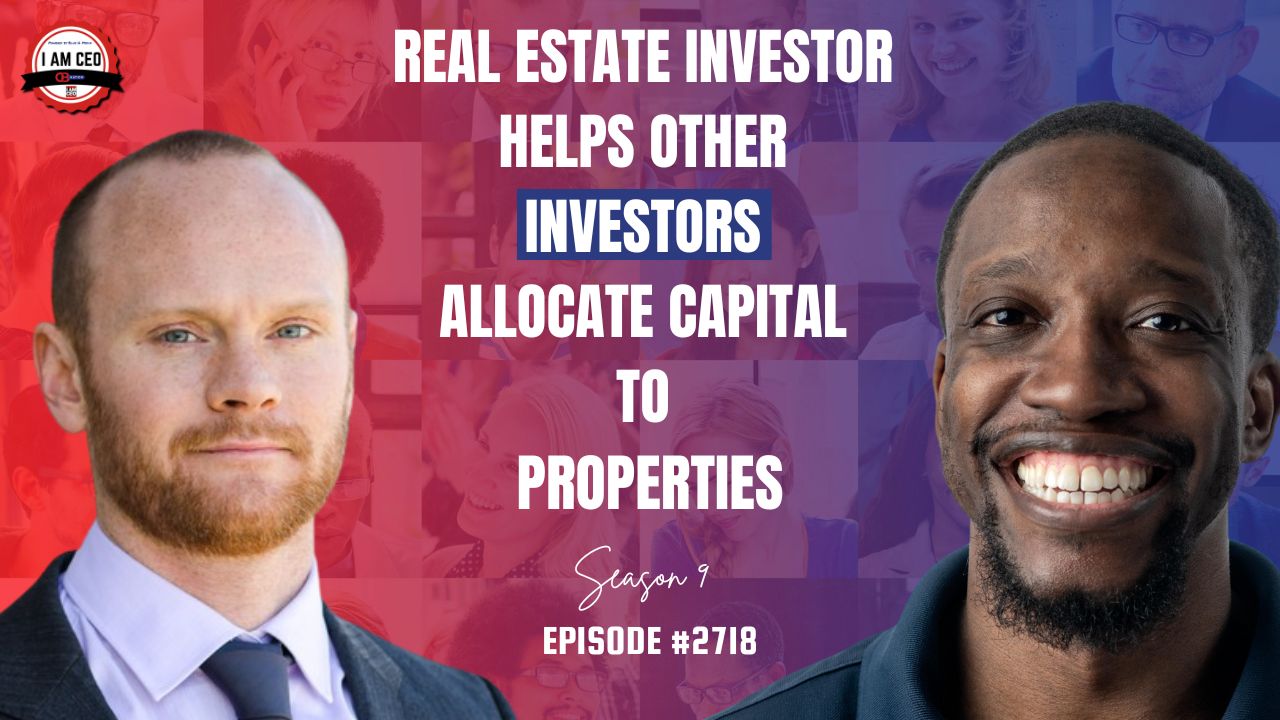
Hunter is a full-time real estate investor and founder of Asym Capital, a private equity firm based out of Los Angeles, CA. Since starting Asym, Hunter has helped more than 250 investors allocate capital to over 100 properties. He has personally raised more than $30mm in private capital and controls more than $75mm in commercial real estate.
Hunter has been featured in Forbes, Globe St., and Inside Self-Storage, as well as a variety of other media news outlets, podcasts, and radio shows.
Hunter is also the host of the Cash Flow Connections Real Estate Podcast, which helps investors learn the intricacies of commercial real estate from the comfort of their home, car, or office.
- CEO Hack: Books – (1) Double Double by Cameron Herold (2) Miracle morning for entrepreneurs
- CEO Nugget: ‘Who not how' way of thinking about things
- CEO Defined: Focusing on different initiatives on your own schedule
Website: https://cfcmentorshipprogram.com
Podcast: www.cashflowconnections.com
https://cfcmentorshipprogram.com/111-questions
Previous Episode: https://iamceo.co/iam422-real-estate-investor-helps-other-investors-allocate-capital-to-properties/
Check out one of our favorite CEO Hack’s Audible. Get your free audiobook and check out more of our favorite CEO Hacks HERE.
Transcription:
Hunter Thompson 00:00:
Who not how has been an incredible way of thinking about things. You guys have done tremendous interviews with high performers in a variety of sectors. There's many, many ways to make money. There's many, many ways to be productive. There's many, many ways to run a business. What you don't want to do is be an amalgamation of all of these people's suggestions. So I would find a couple of people that you feel just speak intimately to you, to your gut, and go all in on their perspective. Use their success as a playbook, go directly towards them. If you find a situation where they went left, when you want to go right, find someone who went right at that pivot point and follow their success. And so it's not about the strategy, it's about identifying the people and replicating their moves.
Gresham Harkless 01:11
Hello, hello, hello, this is Gresh from the I Am CEO podcast and I have a very special guest on the show today. I have Hunter Thompson of ASM Capital. Hunter, it's awesome to have you on the show.
Hunter Thompson 01:19
Hey, thanks again for having me on.
Gresham Harkless 01:21
No problem. Super excited to have you on. And what I wanted to do was just read a little bit more about Hunter so you can hear about all the awesome things that he's doing. And Hunter is a full time real estate investor and founder of ASM Capital, a private equity firm based out of Los Angeles, California. Since starting ASM, Hunter has helped more than 250 investors allocate capital to over 100 properties. He has personally raised over $30 million in private capital and controls more than 75 million in commercial real estate. Hunter has been featured in Forbes, Globe Street, Inside Self Storage, as well as a variety of other media outlets, podcasts and radio shows. Hunter is also the host of the Cash Flow Connections real estate podcast, which helps investors learn the intricacies of commercial real estate from the comfort of their home, car or even their office. Hunter, are you ready to speak to the immunity? Oh yeah, let's do it. So to kick everything off, I want to hear a little bit more about what I call your CEO story. What led you to get started with your business?
Hunter Thompson 02:15
Yeah, so I mean, to be honest with you, a lot of people talk about 2008 in the investment world as being their big moment. It was a big moment for me, but not for the reason it was for a lot of people. I think that I was insulated from what was going on with the economy. I was still in college in 2008. So when that happened, I basically was fascinated by the amount of opportunity that was presented just based on looking things in from a historical basis and just also intuitively understanding that there was going to be an opportunity. When blood was in the streets, I thought it was a very pronounced version of blood being in the streets. So what happened was I jumped all in, focusing first on education, learning as much as I could about stocks, bonds, et cetera, and invested and had success as most people did, investing in 2008. But it wasn't until 2010 that I really had my kind of last straw moment with the stock market.
And this is something that a lot of people don't talk about, but for me, it was just extremely pronounced. It was the European debt crisis. So I had experienced some gains coming out of 2009, lows or so, and thought I was well on my way to building a career in the stock market. And basically 2010 happened, which meant there was incredible volatility in the European markets. It was very similar to what United States Focused Drug had dealt with in 2008. And things like central banks were freezing up in Europe, but it was causing the US Markets to go completely insane. And I remember watching CNBC and they were talking about the grease bond yields all of a sudden, as if this was important. And I should have known. They're saying, if the grease bond yields remain below 7%, the S&P 500 is going to be fine. But if it goes above 7%, the S&P 500 was going to collapse. And I was thinking, under what circumstance was I going to be able to predict that or mitigate that risk? Or like, how can I control this? This is the whole point. And that's when I really started just trying to find a simplistic investment vehicle where just an individual person or a small company could actually mitigate the risks associated with the investment. That quickly led me to real estate.
Gresham Harkless 04:12
Now you say Nick, and I definitely can, you know, speak to being also in school in 2008, when that was happening, and insulated as well. And then I too, I didn't go into real estate, but I read so much, I had no idea. But I remember hearing one of the things I think I read from a Robert Kiyosaki book was that a lot of the Fortune 500 companies were actually founded during an economic depression. So a lot of times you kind of spoke to when those things happen, there is actually a tremendous amount of opportunity. A lot of people make a tremendous amount of headway, largely due to that. But like you said, I think anytime you're thinking about putting your money into something you want to be able to understand, at least to a degree, and to have all these different moving parts that you have no idea exactly what does what. It's really hard and can kind of lead to some sleepless size, I imagine.
Hunter Thompson 04:55
Exactly. And I just didn't feel like it was necessary to expose myself to those kinds of risks to get returns that I thought were achievable otherwise. Now, at the time, I didn't really know it was out there, but thankfully, you know, I actually moved to California at that time, and California was devastated by the real estate collapse there. You know, I think, like, 50% of all the foreclosures in the United States that took place at that time were only in five states. It was really, really pronounced, and California was one of them. And the reason I say that is for two reasons. Number one, valuations were very favorable in California at the time because prices were really depressed. But more importantly, a lot of people lost their shirt. And so when I started learning about this business and I started networking with people, I quickly found myself networking with very successful individuals that were able to weather that storm. And that's something that I've got to be always grateful about, because I built my career based on what I learned from my mentors, know people that I ended up becoming good friends with. Right.
Gresham Harkless 05:49
Yeah, that. That makes perfect sense. So I. I know you touched on it a little bit. Can you derail a little bit deeper? Tell us a little bit more about your business and also, of course, about your podcast.
Hunter Thompson 05:57
Yeah, sure. So I'm the founder of Asym Capital, and basically, we take a passive approach to investing. So what this means is that typically in real estate, you may have a situation where you buy a property. You may even have a property manager manage that property, but if something goes wrong with the property, the property manager will call you. Okay, that's what I continue. I consider that an active investment. The types of investments that we have, we invest in commercial properties where there's an extra layer between the passive investors and the property. So you have the property, like, let's say, a multifamily property, and then a property manager, and that property manager interfaces with a, quote, operating partner or a operator. But under no circumstance does the operator call the passive investor and say, hey, something's wrong with the toilet. We need your help. You need to fix this. So what happens is you can participate in these incredibly lucrative deals. Mobile home park business, the self storage business, office, retail, et cetera, but you don't have to be an expert in those particular asset classes. And this just opens up the door so that you can be actually diversified. Because what I saw was taking place in the stock market is that none of this stuff is actually different. Like if Apple takes a dive, everything takes a dive. And if something big happens in the economic market, like if there's a challenge with Greece bond yields, for example, everyone's going to suffer.
But with the self storage business, for example, if the property is rented, you're making money. If it's not, you're not. And it doesn't matter what happens with the grease bond yields, it just simply doesn't. So you're limiting the amount of unknowns and therefore you're limiting the risk. So I really like being able to do that because you can diversify into a variety of different asset classes at the same time. You don't have to dedicate your entire life to learning only about office complexes in southeastern Florida. You can rely on someone that's spent their whole life focusing on that and invest passively with them.
Gresham Harkless 07:42
That makes perfect sense. A lot of times I say success is a team sport. A lot of times, you know, making sure that you have the team, you're able to lean into people's or on people's expertise and their, you know, things that have happened in their lives and their businesses and all the things that they've read, then you can increase the likelihood of you being successful, can always guarantee. But you can also increase it because that's what you're trying to do is try to increase that likelihood of that happening 100%.
Hunter Thompson 08:04
100%. I'm a huge proponent of that as well. You know, Dan Sullivan's is someone that I look up to a lot. He talks about unique ability, you know, and I think that if my unique ability is communicating with investors, talking with investors, that's what I'm going to spend most of my time doing. If I enjoy doing podcast interviews, for example, which I do, I'm happy to do this. Now we leverage the background of operating partners that specialize in those particular niches, and we kind of get the best of both worlds, right?
Gresham Harkless 08:28
Absolutely. Absolutely. You're zone of genius. And it might even be related to what I was going to ask you next, which is like your C interest sauce, and it could be for you or your organization, but what do you feel kind of sets you apart or makes you unique?
Hunter Thompson 08:39
Well, I mean, look, the real estate sector is very competitive, right? It always attracts the best of the best. And the reason for that is very lucrative, right? You can make a lot of money, you can generate wealth, you can provide cash flow, it's tax deferred, etc. So I don't have to pitch you guys on that. Most people are familiar with that. But I particularly like the podcast medium. Even within the podcast medium, again, very saturated, very competitive. Our podcast is really focused on the extra layer of depth. So when we have conversations with industry leaders, we're going to ask those third, fourth, fifth questions to actually give you the level of expertise that an expert would have. So our podcast is an amazing podcast if you are actually interested in becoming an expert in the real estate sector some degree. Now, if you're just interested in kind of casually learning about real estate, you want to know, you know, what it means to invest in real estate or accept something like that. There's plenty of great podcasts out there. That's not really what ours is.
But this has resulted in something really fascinating. I didn't intend to create a podcast that was focused on depth. I just created a podcast that I knew that I would learn something during every interview. And so that's my motivating factor. I love to have really detailed conversations with industry leaders, but what the result has been, that it's actually made a much more scalable business for myself, my firm, because the listeners are highly educated. So when we get on a conference call with them, we talk about the details of investment, they're very, very convinced, not only of just generally speaking, passive investing, for example, or the benefits of investing in a particular asset class, even the details, because they know where to look. So it's resulted in an infrastructure which attracts highly curated investors that are ready to invest. And then they see the podcast and the material that we put out. And I frequently have investors go through our entire investment process, invest $200,000 that have never spoken to me before. Why? Because they know me intimately. Because of all the work we put out there with the podcast medium and a variety of other things.
Gresham Harkless 10:37
Exactly. That. That makes perfect sense. So I wanted to switch gears a little bit, and I wanted to ask you for what I call a CEO hack. And this might be an Apple book or a habit that you have, but what's something that makes you more effective and efficient.
Hunter Thompson 10:49
So I. There's probably been a lot of books mentioned a lot of times in this program, so I'll try to give you a couple that haven't been mentioned before. Double Double by Cameron Herold. I think it's my favorite business book. He is the COO of Got Junk. He is an incredible author, and another book that he wrote is Miracle Mornings for Entrepreneur.
Gresham Harkless 11:06
Nice. I appreciate that. Yeah. Because you always need to have that opportunity to kind of leverage that. And if you can make whatever that is into something that's tangible, which sounds like that book does, where you're actually hearing from an entrepreneur and business owner that's been successful on what exactly they're doing, then that definitely helps out as far as doing that. I appreciate you for sharing that hack with us , And now I want to ask you for what I call a CEO nugget. And this is a word of wisdom or piece of advice or if you can hop into a time machine, what would you tell your younger business self?
Hunter Thompson 11:32
Hey, so I'm not going to hop into the time machine because I'm very. I don't want to butterfly myself, a butterfly effect myself out of where I currently am. But I will say that who, not how has been an incredible way of thinking about things. There's so many. You guys have done tremendous interviews with high performers in a variety of sectors. There's many, many ways to make money. There's many, many ways to be productive. There's many, many ways to run a business. What you don't want to do is be an amalgamation of all of these people's suggestions. So I would find a couple of people that you feel just speak intimately to you, to your gut, and go all in on their perspective. Use their success as a playbook. Go directly towards them. If you find a situation where they went left, when you want to go right, find someone who went right at that pivot point and follow their success. And so it's not about the strategy, it's about identifying the people and replicating their. Their moves.
Gresham Harkless 12:24
Absolutely. Yeah. That makes perfect sense. I appreciate you for. For sharing that with us. Because a lot of times, you know, these things that you'll hear are simply ingredients. And you figure out what you want to cook, what you want to prepare. You figure out what ingredients work best for that. Not try to fill everything in the grocery store into your recipe.
Hunter Thompson 12:38
Yes, yes, A hundred percent.
Gresham Harkless 12:39
Nice. And, and I wanted to ask you now my absolute favorite question, which is the definition of what it means to be a CEO. And we're hoping to have different, quote, unquote, CEOs on answer. What does being a CEO means?
Hunter Thompson 12:48
You. Oh, man. To be honest with you, the thing that came to mind when you asked that question is I love being able to focus on different initiatives on my own schedule. Right. So if I find an interesting idea, I can try that without having oversight and saying, no, no, no, no, we're not going to dedicate resources to that. So that's really my definition. Like, one example of this is I'm in the process of writing a book and the reason I get to do that is because I decided that I thought it was going to be a good use of my resources. And that is what I love about owning a business.
Gresham Harkless 13:17
Yeah, absolutely. And I think that a lot of times when you're in other kind of realms or even positions, sometimes you're told you can't do X, Y and Z or it's not profitable or it's not worthwhile. But I think for one, that's where sometimes true innovation happens. And sometimes we get to break down barriers we never thought of. And then like you spoke to, you know, getting an opportunity to kind of create that, that piece of content or a book or whatever it might be is really, you know, something that's one of the most exciting things about being a CEO.
Hunter Thompson 13:43
Can I add something to that real quick? Because I think your listeners will be sympathetic to this. I mean, I had, as we all have, some scary moments in my progression towards entrepreneurship. And for me, the most serious moment was I was working at a company that helped realtors get on Google on the first page of Google. So it was a sales position and I had an injury in my right shoulder and had to get an MRI done. Okay. I went in on Thursday and said, hey, look, I'm not going to be able to come in on Friday because I have to get an MRI, right? Here's my doctor's note or whatever. And the way that they looked at me was like, if a 4 year old said that he just took a shot of Captain Morgan's, it was like, you didn't like talk to hr. Like you didn't give us two weeks notice that you're going to miss this one day. It was like, I just, maybe that's common in the corporate world, you know, I, I don't know. But I, I knew that that wasn't going to be my future. You know what I mean? And so that's what it means for me to be a CEO is that if something goes wrong or if I have some challenge come up, it's like there's the freedom to make that choice. So if y' all are listening to this and you haven't, you didn't want to jump over the hump. I'm telling you, there is tremendous volatility in the world of entrepreneurship, but the freedom is incredible. Absolutely incredible.
Gresham Harkless 14:53
Yeah, absolutely. I appreciate you for sharing that with us. Cause I think a lot of times, you know, I, I, I'm a big believer in things happening for a reason. So not to say that specific thing happened for a reason, but I think we can, you know, when we have the perspective that everything happens for us, not necessarily to us, we start to see that those little small things are showed us, shown to us sometimes early on to make us make some of those decisions that we make. So I think, definitely I appreciate you for telling that story because I think we have things that might be in our lives that happen. We might ignore those signs, so to speak. But it's important to kind of see that and understand that and build whatever we want. If we don't like the company we work for, then maybe, you know, we have a great opportunity to kind of build something that can have the values that we are working on ourselves.
Hunter Thompson 15:33
Yeah, absolutely.
Gresham Harkless 15:34
Nice. Well, Hunter, thank you so much for your time. What I wanted to do was pass you the mic, so to speak, just to see if there's anything additional you can let our readers and listeners know and then, of course, how best they can get ahold of you and listen to your podcast.
Hunter Thompson 15:45
Yeah, well, I mean, first of all, like I mentioned, I think going all in is really, really the key. There's basically two options. So you can go all in or you can make excuses. And at every stage of everyone's career, there's always someone that's more successful than them. And, and every time you see them as humans, what you want to do is say, well, they're more successful than me because of X. And that's just it. And you can check out, and that's the easiest cop out. And trust me, you know, like the people that I've been able to work with, it happens at the highest level. So if you're raising a hundred million dollar fund, which is like a massive fund in my business, and there's someone that has a $500 million fund, the person with a hundred million dollar fund goes, oh no, yeah, well, he's politically connected or whatever. It's just like a cop out. It's like, dude, you have no reason to cop out. You're clearly like at a high performer, so don't let that happen at your level either. And again, it just I cannot stress that enough. And in terms of contacting, you can find our educational resources at cashflowconnections.com the podcast and iTunes is Cash Flow Connections. That's three words. And if you're interested in investing or learning about our investment opportunities, it's asymcapital.com a s y m capital.com awesome. Awesome, awesome.
Gresham Harkless 16:51
Well thank you so much Hunter. We'll make sure to have those links as well in the show notes so that everybody can check it out and follow up with you, download and listen to the podcast. But again, appreciate all the awesome things you're doing and appreciate your time even more. And I hope you have a phenomenal rest of the day.