IAM2739 – Founder and CEO Builds Complex Custom Solutions Through Software
Special Throwback Episode with Simon Chatfield

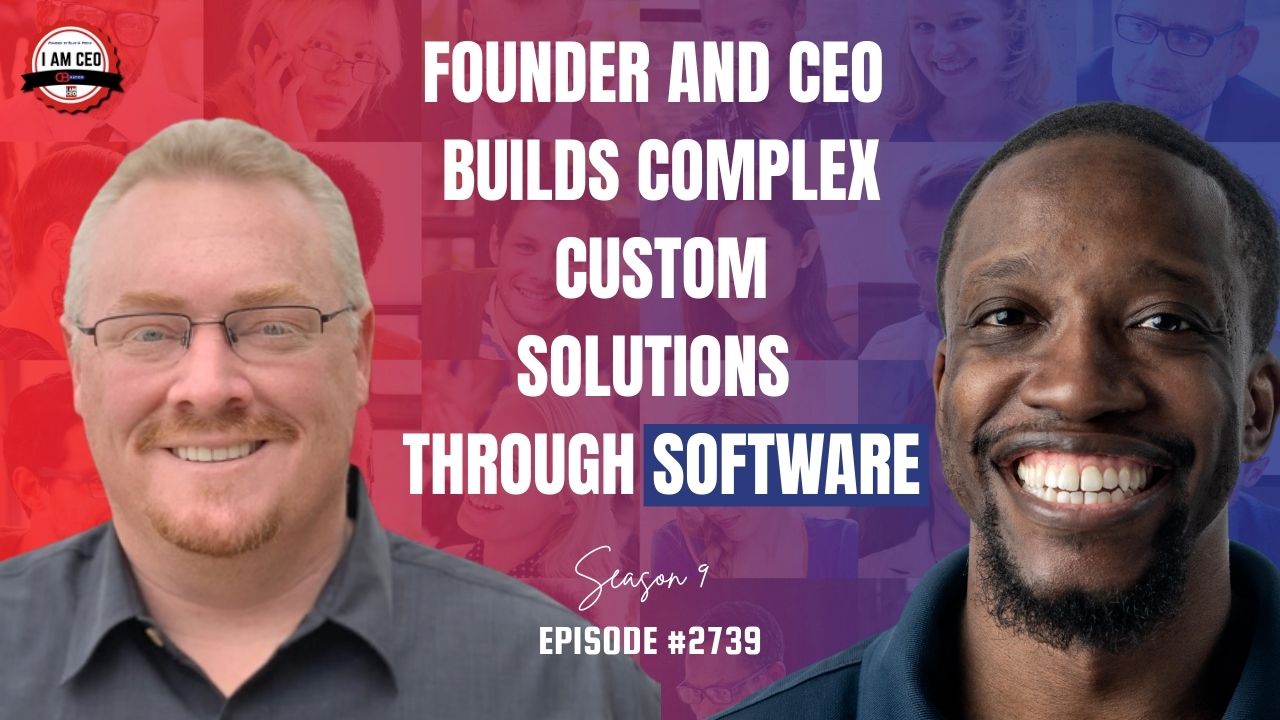
For 15 years, OptimumHQ founder and CEO Simon Chatfield owned a successful custom software development company that built custom software applications for global companies including Apple, ESPN, and American Express, plus hundreds of SMBs. He learned that big and small companies alike faced similar challenges. Business leaders just want software that truly solves their specific needs, and they don’t want all kinds of extra systems they don’t need. Pioneering the concept of dynamic data and company-specific workflows, Simon and his team created a new adaptive software platform to quickly build complex custom solutions without custom code, called OptimumHQ.
- CEO Hack: Taking the time to focus as early as possible
- CEO Nugget: Belief in yourself
- CEO Defined: Being a leader, responsibility holder and the cheerleader
Website: https://www.optimumhq.com/
Youtube: https://www.youtube.com/channel/UCY2QdfuGvazqCcYR-5rGb1w
LinkedIn: https://www.linkedin.com/company/optimumhq/
Facebook: https://www.facebook.com/OptimumHQ
Twitter: https://twitter.com/optihq
Instagram: https://www.instagram.com/optimumhq/
Previous Episode: https://iamceo.co/iam430-founder-and-ceo-builds-complex-custom-solutions-through-software/
I AM CEO Handbook Volume 3 is HERE and it's FREE. Get your copy here: http://cbnation.co/iamceo3. Get the 100+ things that you can learn from 1600 business podcasts we recorded.
Hear Gresh's story, learn the 16 business pillars from the podcast, find out about CBNation Architects and why you might be one and so much more. Did we mention it was FREE? Download it today!
Transcription:
Simon Chatfield 00:00
Believe in yourself sooner. And so, I mean, when I first started my business, I was probably 25 years old and I was confident. I knew what I could do in the software, I knew what the things I could accomplish. But there was still kind of that nagging thing behind me is like, I'm getting these clients, I'm like, do they realize I'm just some 25 year old kid pretending I can do this? And it took me a while, it took me six months, a year plus to get the confidence in myself that my customers and the people around me already had them, you know, and I don't want to say ever being to be arrogant or egotistical or anything like that. It's really just being confident in yourself and being able to make the decisions and say, hey, I really can do this.
Gresham Harkless 01:08
Hello, hello, hello, this is Gresh from the I Am CEO podcast and I have a very special guest on the show today as Simon Chatfield of Optimum hq. Simon, it's awesome to have you on the show.
Simon Chatfield 01:17
Thank you. I'm happy to be here.
Gresham Harkless 01:18
Super excited to have you on and what I wanted to do was read a little bit more about Simon so you can hear about all the awesome things that he's doing. And for 15 years, Optimum HQ founder and CEO Simon Chatfield was owned a successful custom software development company that built custom software applications for global companies including Apple, ESPN and American Express, plus hundreds of small to medium sized businesses. He learned that big and small companies alike face similar, similar challenges. Business leaders just want software that truly solves their specific needs and they don't need all kinds of extra systems that they don't actually need. In addition, pioneering the concept of dynamic data and company specific workflows, Simon and his team created a new adaptive software platform to quickly build complex custom solutions without custom code. And that's called Optimum hq. Simon, are you ready to speak to the I AM CEO community?
Simon Chatfield 02:06
Let's do it.
Gresham Harkless 02:07
Let's make it happen. So to kick everything off, I wanted to hear a little bit more about what I call your CEO story and what led you to get started with the business.
Simon Chatfield 02:13
Wow. So kind of like as you led in the intro, I Started by doing, you know, back in 2001, I started my software consulting company. So I had been working for another software consulting company. Got to a point where it's like, man, I could, I could do better. I could do better than these guys. So kind of struck out on my own a month before September 11th. So it was like August of 2001 and September 11th happened. I was like, oh my gosh, I made the biggest mistake of my life. However, everything turned out to be okay. You know, when you're small and nimble and just starting out, you've got a lot of, if you have nothing but opportunities in front of you. So kind of went to that, those periods of, you know, you know, scrapping around, doing any type of consultant type work I could get. Eventually grew that company up to 60 or so folks. Software engineers, project managers, business analysts again doing stuff for American Express, intel, idm, Apple, espn. A bunch of companies that everybody loves or has heard of at least, and hundreds of small ones. So I kind of got to a point in 2012, I started thinking, you know, there's a better way to do this, kind of build software for companies. And that and the allure of just saying, hey, if I could build a product and I wouldn't need to go to the kind of feast and famine of a consulting company or service company, wouldn't that be a fantastic thing? So actually started building what is Optim HQ today back in 2012. In 2014, I was ready to effectively say, okay, I'm ready to exit the custom world and go full fledged into optimistq. That being my first, actually sold that company. The first time you go through a company sale, you find out, hey, there's actually some strings attached here. So I had to become the CTO of the acquiring organization for a period of roughly two years. The unofficial official start of Optim HQ was in January of 2017. So we've been around for about two and a half years now and just doing fantastic.
Gresham Harkless 04:00
Nice. I definitely appreciate that because I think a lot of times when we are creating something, it never seems like it's a perfect time and sometimes things happen. You're like, oh, wow, I shouldn't have done that. But then we can always look back and say, hey, I understand why all those things happen, at least to some degree. And at least it came out exactly on the good note, at least.
Simon Chatfield 04:20
Yeah, exactly. We are the culmination of our experiences. So having the ups and downs and, and the valleys and mountains and all kind of stuff, it's all Part of the learning experience and, and how you get to the next stage in your, in your career.
Gresham Harkless 04:32
Absolutely, absolutely. And, and I know you, you talked about, you know, starting out doing the consulting business and switching over to Optimum hq. I wanted to hear a little bit more about that and how also you decided to make that shift and when you, or if it was something that just was that light bulb, that moment that say, hey, I want to actually focus on this instead.
Simon Chatfield 04:49
Yeah, it kind of was a light bulb moment. So it was, you know, it was effectively going to a point where we found ourselves working with a multitude of different companies, like we said, kind of large and small, and we found ourselves in the, in the custom coding world. You find yourself doing a lot of the same things over and over. So you see commonalities across all of your clientele. So they all need some level of user management, some level security role management, all these kind of typical type building blocks. And to be truly custom, you kind of need to start that from, from scratch or implement into something that they might already have. Right? But really you find yourself solving, you know, 50% of the work is solving things that really don't need a solution because it's just standard stuff every company kind of needs or every application kind of needs. So seeing that and seeing that kind of parallel between the different companies, we, the first iteration we had what we call kind of our toolbox. So we had just a slew of things. And hey, if we just need to bring in user management, we just copy this in and we say, okay, here you can have this go now as a customer of ours. And we would build upon it. And it got to a point where our toolbox was just getting so strong and it's like, you know, why, you know, we really have such a, you know, such a tiny little thing that we're actually doing that's custom. But that tiny little piece is so critical to that business because that's what makes them unique, right? It's their processes, it's their data, it's their workflows. So that, you know, if we just focus on just that one little thing, like I think we have something here. So kind of had that, that epiphany type moment and, you know, and then trying to figure out a little period of what, two years until we decided we could do it, and four years or two years after that, so four years total. Realizing that, you know, putting together a system that can really realize that vision is, is quite another story. But, but so far it's been going.
Gresham Harkless 06:31
Really well, yeah, that makes sense. But I appreciate you for breaking that down because I think a lot of times people, sometimes people have ideas on what to create and they think you just kind of wake up and it happens. But a lot of times it happens over having that experience and that expertise that you put in and be able to see kind of the forest for the trees and say, hey, wait a minute, I've done this on the last hundred or so projects. So maybe this is in our toolkit and this starts to build and build and build and all of a sudden you have a product in it.
Simon Chatfield 06:55
So. Exactly. It's one of those proverbial five year overnight successes, right?
Gresham Harkless 07:00
Exactly. That's actually the short vers.
Simon Chatfield 07:04
Yeah, exactly. Yeah, exactly. Are much longer than that, but we're around five years right now. There you go, There you go.
Gresham Harkless 07:09
So I know you touched a little bit more on Optimum. Could you tell us anything additional back then and then also too, what I would consider like to be your secret sauce?
Simon Chatfield 07:16
Sure. So Optimum HQ is a platform that allows a business to build whatever they need to build without having to write code. So that's really the real crux of it, is that taking out the software engineers and the need for specific software developers puts the power in the hands of the business. The people who say, I really have this need. So being a no code platform that HQ Dells really enables that company to move extremely quickly, inexpensively and efficiently and at the same time have the scalability and stability that they get from their enterprise applications as well. So that's really what the crux of the HQ platform is. And that's kind of broken down into two main pillars. So we have the concept of data sets, so that could be a database or a spreadsheet or files, et cetera, and then workflows, which are just things that can create data, they can manipulate data, kind of the typical workflow processes for business. And that's how businesses become unique. So that's kind of like the two foundational pillars of what optimaq is. And because we come from the background of the enterprise, understanding enterprise level security needs, stability needs, scalability needs, getting that ability not only to the enterprise that could take advantage of them day one, but to put that power in the hands of the small business, small medium sized business, who might not know exactly what they need, but when they're ready to make something unique for themselves, it's basically there for them to get started.
Gresham Harkless 08:36
Yeah, absolutely. And I think that I'm a real big believer proponent of beginning with the end in mind. And so if these small to medium sized businesses have that vision of wanting to grow to be the ESPN's, the Disney's, the Apples of the world, then at least they know that they have that framework in place to be able to do that. And like you said, the ability to customize and add on to meet and reach whatever needs they have.
Simon Chatfield 08:58
Yeah, and it's an interesting thing. So beginning with the end in mind is always a good place to be. But the reality and the truth of it is is that every company is going to change. You know, you could say, hey, this is my end. Very few know what the end is going to look like when they're just beginning. So that ability to modify and change your, your business processes, even your core business itself is something that small business and medium business need to, need to be able to do. So that's one of the big problems with software development today is that you don't know exactly what the end is when you get started. So you get these big long software projects that last 6, 12, 18 months. What you knew, you know, 18 months ago is not what the world is today. Maybe a new technology came out, a new competitor came into the end of the space, maybe a new client has pushed a new product idea in your, in your, into your court. So companies are always adapting how they do business. So having that end goal, that end vision is important. But you also need to realize that when you're going through the software, this process, things are going to change. And that's one of the downfalls of software development is that change is like the, it's the horrible thing around software development. It's scope creep, it's impossible deadlines, it's shifting deadlines, it's, it's ballooning expenses, it's all that kind of stuff. And when that is, is taken out or really that's out of the businesses control at the beginning, you put that back in the business control, they can actually be more responsive and be adapt and that's what optimization does.
Gresham Harkless 10:25
Yeah, I definitely appreciate that. And I think it's so funny that I usually say that to like entrepreneurs and business owners. Like usually, you know, you want to have your own business because you want control, you want to be able to organize things, you want to be able to make decisions. But a lot of times when it comes to like software and technology especially usually kind of feel like they don't have control, they can't really figure out what to do. So I really appreciate you being able to kind of create that and build that, that gives the kind of the power or the control or at least the decision making ability back to those.
Simon Chatfield 10:52
Entrepreneurs and business owners.
Gresham Harkless 10:53
I wanted to switch GE a little bit and I want to ask you for what I call a CEO hack. And this could be an Apple book or a habit that you have, but what's something that makes you more effective and efficient?
Simon Chatfield 11:02
I think taking time. You know, there's the proverbial take the time to sharpen the saw. So you know, I a really good portion of my day, really, really, my day starts around 4am and I'm not the one of those people that says, oh, you have to wake up at 4am to be a successful person at all. But for me, that quiet time before the rest of the family starts, before the deluge of email comes in, is just that time that I can use for either myself if I'm going to be going through, you know, maybe I'm, you know, reading a book to expand my knowledge or I'm catching up on the day's work or I'm putting strategies together for the upcoming quarter or year or really kind of having that, that focus on. Because as soon as you walk into the office as a CEO, your time, you know, you might have a calendar that's chock full, but I guarantee you at the end of the day you're going to have three things on your plate or 10 things, or 30 things that you didn't realize were going to happen during the day. So having that time to really get the focus down, to really focus on what you're doing is probably the most important thing you can do.
Gresham Harkless 12:00
Yeah, that makes sense. And if you're able to do that as early as possible before, like you said, I think the world takes hold and you start to become what I usually always say is like a fireman because you're always putting out fires and problems and doing all those things. It allows you to kind of get that jump on the day so you can kind of be a little bit more in control when things happen.
Simon Chatfield 12:16
So. Got it. There you go.
Gresham Harkless 12:18
So now I wanted to ask you for what I call a CEO nugget. And this is a word of wisdom or piece of advice or if you can hop into a time machine, what would you tell your younger business self?
Simon Chatfield 12:27
Believe in yourself sooner. So I mean, when I first started my business I was probably 25 years old and I was confident I knew what I could do in the software, I knew what the things I could accomplish. But there was still kind of that nagging Thing behind me is like, I'm getting these clients, I'm like, do they realize I'm just some 25 year old kid pretending I can do this? And it took me a while, you know, it took me, you know, six months, a year plus to, to get the confidence in myself that my customers and the people around me already had in me. So that, that confidence, you know, and I, I don't want to say everybody to be arrogant or egotistical or anything like that. It's really just being the confident in yourself and being able to make the decisions and say, hey, I really can do this is probably the one I would, would go back in time and tell myself nice.
Gresham Harkless 13:16
And, and so now I wanted to ask you my absolute favorite question, which is the definition of what it means to be a CEO. We're hoping to have different quote unquote CEOs on the show. So Simon, what does being a CEO mean to you?
Simon Chatfield 13:26 It means being the. That's a, that's a tough one. It means so many different things to me. First and foremost it's being, being the leader and being the person who within your company, within your team is not necessarily the person making all the decisions or calling on all the shots, being the cheer the most, the chief cheerleader. It's being the, the person somebody can go to. So kind of that servant leadership idea, but at the same time not shirking the responsibility that, you know, decisions do need to get made, right. And you know, not being afraid to make those decisions and whatnot, and assisting. But also that's all about caring as well. So I really care about each and every one of the employees over at OptumHQ and caring about them not only as far as their corporate or their optimum careers, but what's best for the employee or the person. Right? So at Optim HQ is everything about family first. So we've got open policy from that perspective. If you got something that's going on in your family, go take it. Because your family is what's most important to an individual, to an employee. And I totally get that and I understand that and I expect that. But even going beyond that, what's the best thing for the employee in or outside of the company? And the best thing for the employee is to go expand their career and spread their wings and go do something else. I am all for it and I'm definitely sad to see them go. I never happened to see an employee go, but nothing makes me happier than seeing somebody take the next step in their career and Knowing that I was a part of helping them along the way.
Gresham Harkless 15:02
Yeah, that makes perfect sense. And it definitely kind of speaks to that aspect that I think a lot of people forget when it comes to business is that human aspect and the people. And that when you peel back the onions of business and systems and marketing and all these things that we're all kind of made. Businesses are made up of people. And people have things that they're going through with their family, they have successes, good things, bad things, so on and so forth. But to be able to have that culture that allows that to happen and cultivate and for somebody to grow as a person is definitely something that's huge.
Simon Chatfield 15:31 Absolutely. Nice.
Gresham Harkless 15:32
And Simon, I appreciate your time even more. And what I wanted to do was pass you the mic, so to speak, just to see if there's anything additional you can let our readers and listeners know and then of course, how best they can get a hold of you and find out about all the awesome things you guys are working on.
Simon Chatfield 15:45
The best, best way to get a hold of me is obviously through website, email, all kind of fun stuff. So go ahead, go to optimhq.com check out what we can do. And I would say as far as parting thoughts, I guarantee everybody out there listening right now or watching right now is going through some level of software struggle, right? So you go through the beginning where you've got this base core software that isn't quite doing what you needed to do and you're bridging gaps with spreadsheets. And then if you go to the next level, you've got some niche software applications which are kind of helping you out and helping you be unique in the marketplace. And then you get to the next level of software development or ERP implementations, and then you find yourself doing the whole thing over and over again. So, you know, there is a better way to do it. You know, go take a look at some of the no code platforms, no code slash, low code platforms. Take back the control of your company and build things quickly and efficiently for yourself and hope you give up optimistq a try.
Gresham Harkless 16:42
Nice. I definitely appreciate that. And as the saying goes, you know, there has to be a better way. And I appreciate you for actually creating that better way so that you can help us out as entrepreneurs and business owners. We will have your links and information in the show notes as well so that everybody can follow up with you. But Simon, thank you so much and I hope you have a phenomenal rest of the day.